
ChessWorld.net, founded in 2000, is an online chess site. Play relaxed, friendly correspondence-style chess — with online daily, turn-based games — at your own pace.
Chess Notation Introduction
Algebraic chess notation is the universal language used to record moves, study famous games, and follow tournament broadcasts. This beginner's guide explains how to read and write grid coordinates (e.g., e4, Nf3) and understand special symbols for checks and captures, enabling you to learn from chess literature.
🔥 Language insight: Notation is how you read the books that make you better. If you can't read, you can't learn. Master the basics of the game, including notation, to unlock all future learning.
What is Algebraic Notation?
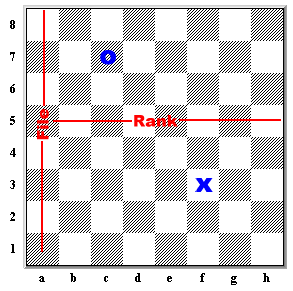
Algebraic notation is the most common system to write chess moves. It uses letters and numbers to identify each square and piece on the chessboard.
Chessboard Coordinates
Piece Notation
Each piece is represented by a letter:
| Symbol | Piece | Symbol | Piece |
|---|---|---|---|
| K | King | Q | Queen |
| R | Rook | B | Bishop |
| N | Knight | Pawn (no letter) |
How Moves are Written
Moves are written by stating the piece (except pawns) and the square it moves to.
- e4 — Pawn moves to e4
- Nf3 — Knight moves to f3
- Bb5 — Bishop moves to b5
Captures and Special Moves
- exd5 — Pawn captures on d5
- Nxe5 — Knight captures on e5
- O-O — Kingside castling
- O-O-O — Queenside castling
- e8=Q — Pawn promotion to queen
- + — Check
- # — Checkmate
Why Learn Chess Notation?
- Record and review your games
- Read chess books and watch tutorials
- Follow lessons and commentary
- Communicate moves clearly
- Essential for tournament play
📝 Chess Notation Guide
This page is part of the Chess Notation Guide — Learn algebraic chess notation: coordinates (a1–h8), piece letters, captures, checks, castling, en passant, and promotion.